ASEAN Biomass Energy Expo 2027
Global energy markets are shifting fast. High fossil fuel prices and rising carbon taxes are forcing industrial energy users to find cleaner alternatives. While Europe focuses heavily on meeting strict RED III climate rules, Southeast Asia is doing the heavy lifting. The region is now the world’s main supply hub for biomass, transforming agricultural and wood waste into industrial fuel.
To support cross-border market intelligence, policy alignment, and international supply chain development, Global Biofuel Portal has formally entered into a strategic media partnership with the ASEAN Biomass Energy Expo. Scheduled for March 17–19, 2027, at the Impact Exhibition Center in Bangkok, Thailand, the event brings together pellet producers, equipment manufacturers, project developers, technology vendors, and industrial energy buyers from across Asia-Pacific and global trade networks.
The official event page and registration details can be found at: https://www.aseanbiomassenergyexpo.com/article/show_article.php?id=349
Regional Market Dynamics and Bioenergy Expansion
The global biomass fuel market is expanding rapidly, projected to grow from $54.9 billion toward $84.2 billion by 2033 at a compound annual growth rate of 6.3% (Source: Coherent Market Insights). Concurrently, the total market value for global biomass power generation is on track to expand from $105.8 billion toward $152.68 billion, supported by utility co-firing policies and industrial thermal fuel switching (Source: Fortune Business Insights). Asia-Pacific holds a dominant regional position, capturing over 44.5% of total global biomass fuel market volume as power utilities, heavy manufacturing facilities, and district heating plants transition away from coal and heavy fuel oil (Source: Coherent Market Insights).
In parallel with general bioenergy expansion, international trade in densified solid biofuels continues to scale up. The global wood pellet market reached $22.45 billion and is projected to surpass $34.90 billion, driven by surging demand across power generation and commercial heating sectors (Source: Fortune Business Insights). Asia-Pacific represents the fastest growing regional consumer for densified fuels, with regional wood pellet consumption projected to expand significantly as long-term feed-in tariffs, renewable portfolio standards, and co-firing mandates across Japan, South Korea, and expanding Southeast Asian industrial zones take full effect (Source: Mordor Intelligence).
Southeast Asia as a Feedstock and Processing Powerhouse
At the same time, regional trade in densified agricultural residues, agri-pellets, and industrial wood pellets continues to surge. Southeast Asian agro-industrial processing sectors generate over 200 million tons of biomass residues annually from sugarcane bagasse, palm oil waste (such as empty fruit bunches and palm kernel shells), and rice husks, representing an estimated cogeneration potential of up to 19 gigawatts (Source: ResearchGate). This massive agricultural output provides a resilient raw material foundation for high-density pelletization and export logistics.
Thailand alone accounts for nearly 80 million tons of annual agricultural and forestry waste potential, making Bangkok a natural hub for processing technology deployment, drying engineering, and international trade matchmaking (Source: ResearchGate). Supported by national policies promoting higher renewable energy integration in local manufacturing and thermal heat applications, Thailand’s domestic biomass market continues to scale toward $194 million, reinforcing its position as both a major regional producer and technology deployment center (Source: Metastat Insight).
Connecting Technical Standards with Commercial Execution
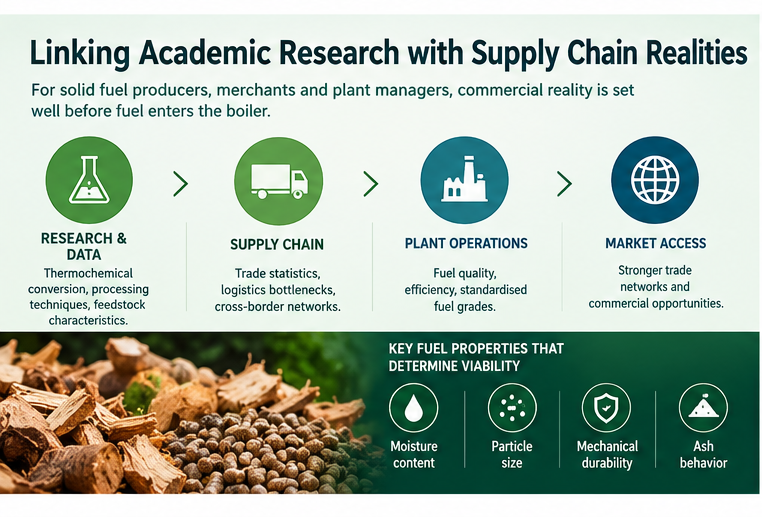
Commercial viability in the biomass sector depends heavily on matching precise feedstock specifications with combustion technologies and international shipping logistics. Critical physical and chemical parameters, such as moisture content, ash fusion temperature, calorific yield, bulk density, and transport economics, dictate whether an agricultural residue or wood fraction can be successfully processed, certified, and exported.
Through this partnership, Global Biofuel Portal integrates its digital media reach, technical analysis, and industry databases with the regional network of the ASEAN Biomass Energy Expo. The portal provides continuous coverage of wood pellets, agri-pellets, fuel briquettes, charcoal, and liquid biofuels like biodiesel, helping market participants locate reliable counterparts across Europe, Ukraine, and high-growth Asian corridors. By bridging scientific advancements with real-world trading, this collaboration supports standardization, cleaner production, and international business expansion across the bioenergy value chain.